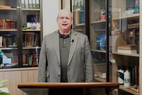
Hong Kong Baptist University scholar Dr. Andrew Loke presented the life of Robert Morrison, the first Protestant missionary to reach mainland China, as a model of perseverance under persecution, rigorous scholarship, and deep respect for Chinese culture in a presentation on the missionary's legacy.
Loke argued that Morrison's example calls the church today to fund long-term, culture-building work rather than seek only quick evangelistic results, and to use tools such as artificial intelligence wisely in making the case for the Christian faith.
He spoke at an online gathering on September 23, co-hosted by the World Evangelical Alliance (WEA) and the World Chinese Christianity Alliance (WCA). The event marked the WEA's 180th anniversary and looked ahead to the 220th anniversary of Protestant missions in China in 2027, dated from Morrison's arrival in 1807.
Under the theme "From Legacy to Horizon: Learning from Pioneers, Mobilizing for 2033," the gathering included presentations on Morrison, James Hudson Taylor and Dr. L. Nelson Bell.
WCA General Secretary Rev. Ezekiel Tan introduced Loke as an "internationally respected scholar, author and leading missiologist."
Loke opened by outlining three parts to his talk: Morrison's pioneering work in Bible translation and lexicography, his academic and cultural engagement with China, and the lessons his life offers the church today.
Morrison was born in 1782 to a devout Presbyterian family in Northumberland, England. Loke recounted his conversion at 15, when what Morrison described as "a deep awakening of guilt" led him to seek God's forgiveness.
He was trained for ministry at Hoxton Academy in London and the missionary academy at Gosport. After the London Missionary Society appointed him to serve in China, he undertook further studies in medicine, astronomy, and Chinese in London to prepare for the mission. Ordained at 25, Morrison traveled to China via the United States. Loke recounted a ship owner's skeptical question about whether Morrison expected to make an impression on "the idolatry of the great Chinese Empire."Morrison's reply, Loke said, has become famous: "No sir, I expect God will."
After 113 days at sea, Morrison arrived in Macau and then Canton, becoming the first Protestant missionary to reach mainland China. His proficiency in Chinese later led to his appointment as an East India Company translator, giving him a legal basis to remain.
He completed a translation of the New Testament and, in 1814, baptized his first convert, Tsae A-Ko. He went on to found the Anglo-Chinese College in Malacca to train future missionaries before they entered China, complete a translation of the whole Bible in 1819 and a Chinese-English dictionary in 1823, and ordain the first Chinese Protestant minister, Liang Fa, in 1827. He died in Canton in 1834.
Loke gave particular attention to Morrison's Bible translation work. Earlier, incomplete Catholic translations of the New Testament existed, including one by Jean Basset based on the Latin Vulgate; Morrison copied a manuscript of this translation in London in 1806 with the help of a Chinese visitor, Yong Sam-tak, and improved on it.
After arriving in China, he secretly recruited Chinese assistants to help him — a considerable risk, since the Qing government banned the printing of Christian materials. Morrison and William Milne completed their Chinese Bible translation in 1819, and it was published in 21 volumes in 1823. It was not the first complete Chinese Bible to appear in print: a translation by Joshua Marshman and Joannes Lassar had been published a year earlier, in 1822, in Serampore, India. But because of Morrison's network inside China, his version circulated far more widely and became the basis for many later Chinese translations.
Morrison's dictionary, Loke said, was the first two-way Chinese-English and English-Chinese dictionary, running to 4,500 pages and drawing 47,000 head characters from the Kangxi dictionary. It became, in Loke's words, "the common fountain from which later missionaries to China obtained the requisite knowledge of the Chinese language."
All of this was accomplished under severe restriction: Chinese law at the time forbade teaching Chinese to foreigners and made spreading the Christian faith a capital offense, forcing Morrison to study, translate and hold worship services in secret, all while enduring poor health and constant fear for his own safety and that of his Chinese assistants.
By the time he finished his work in 1832, only 10 Chinese converts had been baptized — but Loke said the true measure of Morrison's accomplishment lay not in that number but in the foundation it laid for later missionaries.
Loke also described Morrison's broader academic and cultural standing. His dictionary drew international scholarly attention and earned him the title "father of Sino-British cross-cultural literature". He translated hymns, a prayer book and an outline of Western history into Chinese, and assembled a Chinese library of about 10,000 volumes in England to introduce Chinese language and culture to Europeans.
Loke noted that despite working for the East India Company and, later, in effect for the British Empire, Morrison never advocated using military force to open China.
Turning to lessons for today, Loke pointed first to Morrison's love for God and for the Chinese people — he defended their rights against injustice and worked 12 to 14 hours a day with what one historian called "unwearied perseverance, the most ardent zeal, and indefatigable diligence." His confidence lay not in his own effort but in God's purposes, Loke said, a trust that carried him through setbacks including the death of his wife and infant child from cholera in 1821. "I am determined by the grace of God," Morrison wrote afterward, "to devote myself more and more to this good cause."
The second lesson, Loke said, is the importance of fulfilling what he called the "cultural mandate", building the infrastructure for pre-evangelism rather than seeking only quick results. Morrison's dictionary took years to compile and helped lay the groundwork that later missionaries built on; in the same way, Loke urged Christians today to fund long-term, tool-building projects rather than measure success only in conversions.
He pointed to declining Christian affiliation in Singapore, particularly among younger and more educated residents. Christians, he said, need to be equipped to give a reasoned defense of their faith, and to use artificial intelligence wisely to spread evidence and arguments for the truth of Christianity.
Loke closed by describing his own sense of being personally inspired by Morrison, whose "tent-making," workplace-based ministry as a company translator let him remain in China despite laws that made preaching Christianity a capital offense. He called on Christians today to support business professionals who can gain entry into countries closed to traditional missionaries, and Christian professors in secular universities who can train doctoral students in fields such as philosophy, history, and the relationship between science and religion.
"May Morrison's life and work continue to inspire us," he said. "May God help us to fulfill the cultural mandate and the Great Commission for His kingdom and His greater glory."