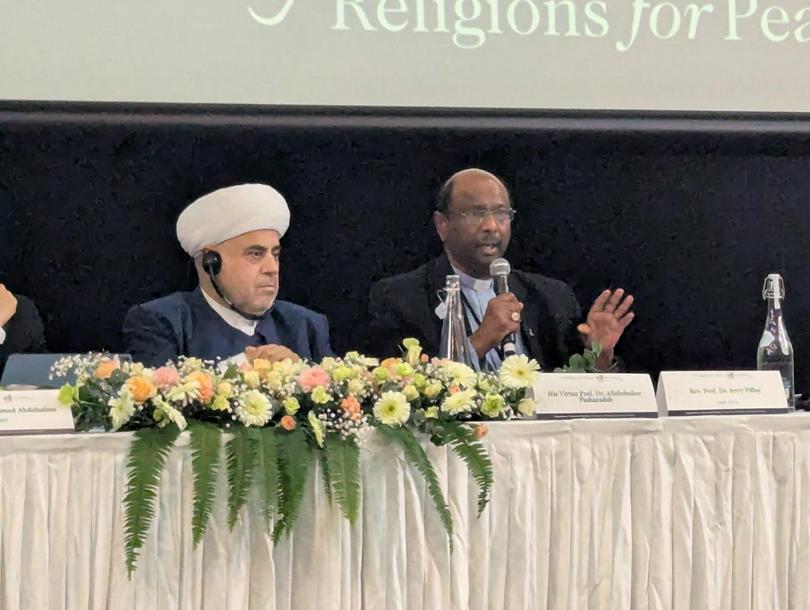
World Council of Churches general secretary Rev. Prof. Dr Jerry Pillay spoke at the Religions for Peace 2026 International Council Meeting, held in Mauritius, 23–25 June, under the theme "Forging Pathways for Shared Sacred Flourishing."
As a panel speaker, he addressed what "meaningful human control" means in the context of AI and lethal decision-making.
"Machines can never be developed to the extent that they could have the uniquely human characteristics of moral reasoning, empathy, and the contextual understanding necessary to make decisions that respect human dignity and the laws of war," he said.
"Without ensuring meaningful human control over a weapons system, the risk of unintended escalation, civilian casualties, and the erosion of ethical boundaries in conflict situations increases significantly."
The use of AI in warfare must align with international humanitarian and human rights law, Pillay urged. "Meaningful human control ensures that human values—such as love, compassion, justice, and the sanctity of life—remain central to decision-making, which is even more critical in times of conflict," he said.
Pillay also offered remarks on "Artificial Intelligence – Human Rights, Dignity, and AI Multifaith Perspectives."
He affirmed the vast potential that such a transformative technology as artificial intelligence has for enhancing the wellbeing of humanity and the living planet.
"From researching and developing new treatments for previously incurable diseases, to finding new ways of averting climate catastrophe and preventing biodiversity loss, to supporting the elderly and the vulnerable, the positive use cases for AI are as wide as the technology is adaptable," he said. "At the same time, it is both urgent and critical that we collectively recognize and mitigate against the risks posed by an emerging technology so powerful that it represents potential civilizational change more than mere technological advance."
Unconstrained, the profit motive has rarely proven to be an engine for humanity's best instincts, Pillay added. "We are therefore deeply concerned by the lack of uniform global regulation of a technology that even many of its pioneers have warned carries potentially existential risks," he said.
If not placed in service to people – all people – AI risks undermining every category of human rights, Pillay said.
"At the heart of our concern is the protection of human dignity, understood not only as an abstract principle but as the lived experience of being recognized, needed, and able to give and receive care in community," he said.
The Religions for Peace 2026 International Council Meeting brought together global, regional, and national leadership to engage in focused dialogue on key global challenges, including artificial intelligence and human dignity, interlinked challenges of climate and debt, and the weakening of international rules-based order. The meeting also served as an opportunity to carry out the governance functions of the International Council while providing space for reflection to inform priorities in the lead-up-to the next Religions for Peace World Assembly.
Read the full text of the WCC general secretary's address
Originally from the World Council of Churches
CCD reprinted with permission