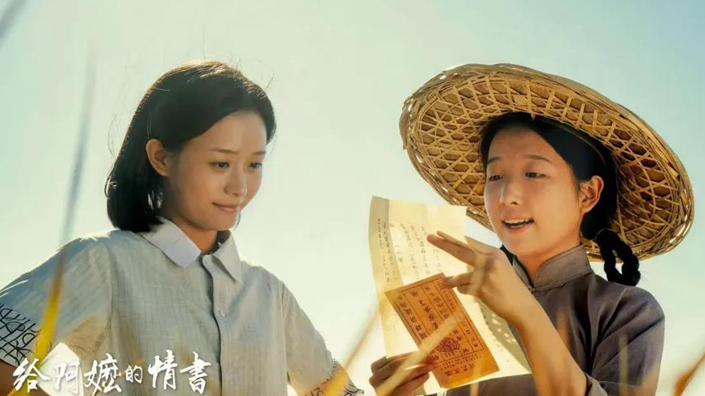
Recently, the Chinese movie "Dear You" (《给阿嬷的情书》) has been a big hit in theaters. What makes the film so moving is not simply its romance, family bonds, or nostalgic memories of a bygone era. What truly touches the audience is something increasingly rare in our time: qingyi (情义).
Here, "qingyi" (loyalty and honor) does not refer to transactional social obligations or the loyalty of brotherhood and family clans. Rather, in human relationships, it refers to qualities such as keeping one's word, showing gratitude, taking responsibility, extending compassion, and being willing to bear costs for others. However, where does such genuine faithfulness and devotion ultimately come from?
A Delayed Love Letter, A Question for Our Age
Before entering the movie theater, I had little expectation that this film would move me. In fact, I had not even heard of it. The only reason I watched it was simple: my wife dragged me along to fill a seat.
In an era dominated by celebrity culture and visual spectacle, a slow-paced, warm-hearted film set among Teochew families who migrated to Southeast Asia hardly seems to become a major casual topic. Yet at even the beginning of the film, I noticed audience members quietly wiping away tears. And as the closing credits rolled, I, too, felt an indescribable emotion well up inside me.
The story itself is not complicated. In the late 1940s, a young Teochew man named Zheng Musheng leaves his wife, Ye Shurou, behind and travels to Thailand to escape the turmoil of war and seek a livelihood. Shurou stays behind, raising their three children alone while surviving on remittances sent back by her husband.
Decades later, their grandson Zheng Xiaowei, burdened by debt, travels to Thailand searching for his grandfather, who was rumored to have become wealthy. Instead, he discovers that Zheng Musheng had died in 1960 while saving someone's life. What shocks him even more is that for nearly twenty years after Musheng's death, a Chinese-Thai woman named Xie Nanzhi—someone Shurou has never even met—continues writing letters and sending money under Musheng's name, quietly supporting the family from afar. Out of gratitude for Musheng's earlier kindness toward her, Nanzhi never marries and spends much of her life repaying that debt of kindness in her own way.
By the movie's ending, Xiaowei finds himself deeply lost. His struggle is no longer merely financial; it is existential. How should a person live? Grandma Shurou does not scold him, nor does she overwhelm him with grand principles. She simply offers the wisdom of her life: "To live with qingyi, and benefactors will naturally appear along the way."
Those words are simple but weighty. In an age that measures everything by value, efficiency, cost, and return, "qingyi" feels like a forgotten word. Yet this almost old-fashioned idea moves countless viewers to tears.
Why?
Perhaps because the movie awakens more than nostalgia. It raises an ancient question about life itself. How should human beings live? What is truly worth spending our lives holding onto?
The Characters Who Embodied "Qingyi"
What makes the movie so moving is not dramatic plots but the personal qualities portrayed in the characters who are ordinary people.
Ye Shurou is the soul of the film. She endures years of waiting, loss, and hardship, yet never loses her sincerity toward others or her commitment to promises. She remembers the kindness shown to her and helps others whenever she can. Even amid suffering, she retains her dignity.
Zheng Musheng speaks little yet carries responsibility through action. His love for his wife is not expressed through romantic words but through steadfast provision and care. His help toward Xie Nanzhi is not a momentary act of generosity but the result of a conviction that once someone becomes his friend, he remains responsible for them.
Xie Nanzhi represents gratitude and repayment. She never forgets the kindness once shown to her, and she spends decades faithfully paying that debt. In an age increasingly inclined to treat relationships instrumentally, her character seems especially precious.
Zheng Xiaowei represents many young people today. Crushed by debt, pressure, and confusion, he seeks both a practical solution and a direction for life. His grandmother's words do not magically solve his problems, but they point him toward a path, not one built on shortcuts, but on becoming a person of integrity.
Together, these characters display certain qualities: faithfulness, gratitude, responsibility, compassion, and a willingness to bear costs for others.
Perhaps that is what "qingyi" truly means.
Why Do We Still Long for "Qingyi"?
Along with the profoundly expressed "qingyi," one of the movie's deepest insights lies in how we still deeply long for it.
In practical terms, "qingyi" rarely seems efficient or profitable.
Zheng gains no obvious reward from helping Xie Nanzhi. Xie spends decades repaying kindness without anyone demanding it. Ye's commitment to principle offers no immediate return.
And yet it is precisely these seemingly impractical choices that move us.
Because somewhere deep inside, we still hold onto a simple conviction: Some promises are worth keeping. Some responsibilities are worth carrying. Some kindnesses should never be forgotten. Some forms of love remain worthwhile, even when costly.
The problem is that although we long for such faithfulness and devotion, we increasingly struggle to live it out.
When pressures mount, we compromise. When interests collide, we make concessions. When costs rise high, self-protection becomes our instinct.
So, we leave the theaters deeply moved while realizing how difficult it is to practice it in real life.
That leads to another ultimate question: Where does this longing for faithfulness, responsibility, and goodness come from?
The Christian Understanding of Passion and Faithfulness
From a Christian perspective, the qualities that move us in this film are rather expected.
Scripture teaches that human beings are created in the image of God. Though sin has deeply fractured human nature, God, through grace, still preserves traces of conscience, compassion, faithfulness, and sacrificial love within humanity.
This means that even people who do not know Christ may display remarkable love and responsibility. And when we witness such qualities, something resonates within us. Because these virtues were part of God's design from the beginning.
"Dear You" moves audiences not merely because it tells a touching story, but because it touches humanity's deeper longing for faithfulness, goodness, and love.
Ultimately, that longing points us back to the God who created us.
The Gospel as the Ultimate Foundation of "Qingyi"
However, longing for loyality and honor is not enough.
We know we should keep promises, yet we fail. We know we should be grateful, yet we forget. We know we should take responsibility, yet we withdraw.
The issue is not ignorance of what is good. The issue is our lack of power to consistently live it out.
For "qingyi" to endure, it requires a foundation stronger than personal feelings, family tradition, or social expectations.
The Christian faith tells us that love originates not from humanity but from God. We love because God first loved us. We learn faithfulness because God Himself is faithful. We learn responsibility because Christ first bore responsibility for us.
The cross of Christ is the deepest expression of this kind of faithfulness and love.
We are faithless, yet He remains faithful. We run astray, yet He seeks us. We are indebted, yet He bears the cost.
On the cross, God reveals a love greater than human devotion: not because humanity deserved it, but because while we were still sinners, Christ died for us.
For Christians, therefore, "qingyi" is not merely a cultural virtue or a matter of personal character. It is a response to the love of God.
Having received such grace, we gain the strength to continue loving, forgiving, keeping promises, and bearing burdens.
What Does This Mean for the Church Today?
The movie also asks the church an important question: Does the church still display faithfulness and love rooted in something deeper?
The church is not a community held together merely by social ties. Its center is Christ. Its foundation is truth. Its mission is the proclamation of the gospel.
And precisely because of this, the church should be a community marked by genuine love.
When the weak come to us, the church, do they experience acceptance and support? When those who have fallen seek repentance, do they receive companionship and help? When brothers and sisters face hardship, are we willing to carry burdens together?
The gospel was never meant to remain abstract doctrine. It should bear good fruit in relationships.
The church's expression of "qingyi" is not simply a reflection of social obligations or rural ethics. It is a witness to the love revealed at the cross. It upholds truth while extending mercy. It calls people to repentance while walking beside them toward restoration.
A person who truly knows Christ neither underestimates sin nor dismisses sinners. Because such a person understands both the seriousness of sin and the preciousness of grace.
Christians, Become Christ's Love Letter to This Generation
The movie may not explicitly proclaim the gospel, but the longing for "qingyi" that it awakens can prepare people's hearts for the gospel.
The movie can awaken a desire for beautiful relationships. However, it cannot fully explain why human beings repeatedly betray trust, avoid responsibility, and wound one another. On the other hand, the gospel not only tells us how we ought to live but also explains why we fail to live that way and leads us to the Christ who forgives, renews, and restores.
Perhaps in an age increasingly lacking in faithfulness and devotion, every Christian should become a love letter from Christ to the world. When others look at us, may they see another way to live: a love unconcerned with gain or loss, a faithfulness that keeps its word, a gratitude that remembers kindness, and a steadfastness that endures through storms without changing.
- Translated by Charlie Li