
For Chinese people today, we often face a recurring question: how should we understand China's long history and cultural heritage? What deserves to be carried forward, what calls for reflection, and how can we reinterpret and renew our culture in today's context?
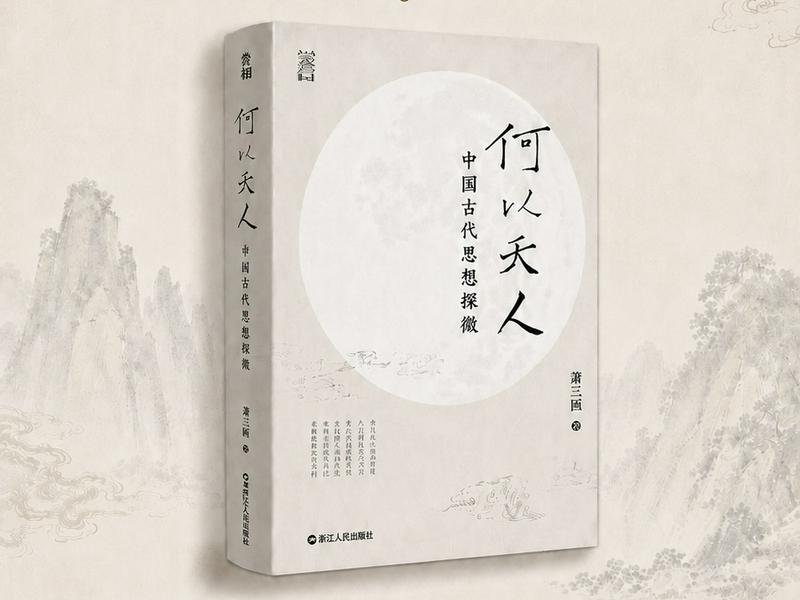
In August 2025, the renowned scholar and veteran media professional Xiao Sanza published his new book Heaven and Humanity: A Probe into Ancient Chinese Thought, offering a panoramic overview of the evolution of ancient Chinese thought.
This August, the Chinese Christian content platform Evangelical Vision invited Mr. Xiao for a live conversation, focusing on his choice of the "relationship between Heaven and humanity" as the main thread for understanding the history of Chinese thought, the three‑thousand‑year development of Chinese intellectual traditions, the limitations within traditional Chinese culture, and how different civilizations can learn from one another.
Evangelical Vision: From a historical perspective, we pay attention not only to major figures such as emperors and generals, but increasingly to economics, technology, institutions, and the everyday lives of ordinary people. Your book, however, approaches Chinese history through intellectual history. In the development of a civilization, what role does thought play? How does it shape the historical direction of a people?
Xiao Sanza: History is never determined by any single factor, but different factors carry different weights in the course of historical development.
Why do I write intellectual history? Because human beings are creatures of ideology; everything people do is guided by their ideas. What we call "thought" is the core of all our ideas—our worldview, our values, and our outlook on life.
Let me give you two examples. During the American War of Independence, Washington, with his prestige, could easily have become a king, but he did not, because his ideology was grounded in the rule of law and in God's law. In contrast, in 1912 China had already become the first republic in Asia—so why did Yuan Shikai insist on proclaiming himself emperor after serving several years as president? Because imperial ideology was deeply rooted in his thinking.
Evangelical Vision: Your book is clear and accessible, and it draws on a wide range of sources from ancient and modern times, both Chinese and foreign. Could you share the background in which this book was written?
Xiao Sanza: The path of my scholarly work has undergone a fundamental shift: from focusing on current realities to probing underlying roots, from examining phenomena to tracing the essence, and from looking at institutions to probing the human heart. I believe a thinker's work should not remain on the surface but should trace things back to their origins.
I worked in media for more than twenty years. Many friends and colleagues, driven by a sense of mission, served as investigative journalists. Solving individual concrete problems is certainly important, but I feel that even if one solves many small problems, it may not necessarily help with solving the larger ones. For example, many social flashpoints can be traced back to a single issue: the loss of faith leads to the loss of love, ultimately resulting in the continual erosion of basic moral boundaries.
There is a sentence on the back cover of my book: we are still living in the continuation of traditional Chinese thought. I believe traditional Chinese thought has already become part of the DNA of each of us.
For example, in many Chinese companies, colleagues call each other "Sister Zhang" or "Brother Wang," which is essentially the Confucian concept of family transplanted into modern society. When hosting a meal, there is usually a main seat reserved for the person with higher rank or older age—this is a typical expression of Confucian ideas of order. And when many people encounter a problem, their first thought is to rely on personal connections rather than follow normal procedures or the path of the rule of law.
Since traditional mindsets still influence Chinese people today, we must ask: is traditional Chinese thought and culture sufficient to meet the needs of this era or even capable of pointing the way forward for the future?
I believe there are at least two issues.
First, can traditional Chinese culture provide inner grounding for contemporary Chinese people, giving rise to a heart of peace and joy? I believe this is impossible. Many people today do not understand what they are living for. Second, can traditional Chinese culture construct a relatively good political and social system? Looking at history, it does not provide sufficient evidence for this either.
So the real question my book seeks to answer is, how can Chinese culture be renewed? This has also been a long‑standing concern of Chinese scholars since the introduction of Western learning to the East. For example, Lin Yusheng proposed the "creative transformation of Chinese tradition," and Li Zehou proposed "transformative creation." The two are largely similar, but in my view, neither has offered a sufficiently convincing solution.
Evangelical Vision: This book uses the "relationship between Heaven and humanity" to thread together three thousand years of intellectual history. You also mention that in historian Qian Mu's "final manuscript," "The Contribution Chinese Culture May Offer to the Future of Humanity," written three months before his passing, he stated, "The unity of Heaven and humanity is the ultimate destination of all traditional Chinese cultural thought." Why did you choose the "relationship between Heaven and humanity" as the theme running through the entire book?
Xiao Sanza: When Sima Qian wrote Records of the Grand Historian, he said, "To investigate the boundary between Heaven and humanity, to understand the changes from ancient to modern times, and to form one's own interpretation." Most people probably pay attention only to the last two phrases and overlook the first. But in fact, "to investigate the boundary between Heaven and humanity" is the most important—it is the premise and foundation of the other two.
In my view, whether in ancient or modern times, whether in China or the West, the most important theme in intellectual history is the relationship between Heaven and humanity.
Existentialism holds that human beings are thrown into this universe, essentially meaning that humans are a kind of floating existence. Yet people inevitably ask what the meaning of life is. The so‑called three fundamental questions of philosophy—Who am I? Where do I come from? Where am I going? —can only be answered by understanding the relationship between Heaven and humanity.
The essence of the boundary between Heaven and humanity is the relationship between Heaven's sovereignty and human agency. In China, this is called the relationship between Heaven and humanity; in the West, it is the relationship between God's sovereignty and human free will. In essence, they are the same.
Evangelical Vision: In your book, you highlight several major "Heaven‑mending efforts," meaning the ways thinkers responded to crises of their times by re‑examining and adjusting the relationship between Heaven and humanity. How did these thoughts change over time?
Xiao Sanza: The common thread is that thinkers of every era built a logically coherent system of thought—one that could provide meaning for life and establish order for politics and society.
In the pre‑Qin period, both Confucius and Mencius revered Heaven, but Confucius lamented, "What does Heaven say?" He believed in revering Heaven, yet did not clearly understand Heaven's intent. By the Qin and Han dynasties, there was a need to unify ideology, so Dong Zhongshu proposed "the mutual responsiveness of Heaven and humanity," though this blended together the Heaven of nature and the Heaven of morality. With the rise of Cheng-Zhu Neo-Confucianism, it was believed that an eternal and immutable "principle" governed the universe. Wang Yangming, however, emphasized that "innate conscience is its own master."
Thus, the Chinese understanding of the relationship between Heaven and humanity roughly went through a shift from Heaven to principle and then to mind. It moved from revering Heaven to humanity replacing Heaven—people increasingly felt that Heaven's mandate was not worth fearing and that they could do whatever they wished. As a result, we lack an absolute standard that everyone can jointly uphold; the human heart easily falls into disorder, and society easily follows. In my view, China's "Heaven" had already completely collapsed by the late Ming. From the Qing dynasty to the present, the Chinese sense of Heaven has never been fully restored, which is why we are often anxious—what, after all, is the purpose of human life?
Evangelical Vision: Francis Schaeffer, author of How Should We Then Live?, believes that as Westerners increasingly turn away from God, society and history decline. Readers may sense something similar in your book.
Xiao Sanza: I very much agree with his view. Ancient Greek philosophy valued human reason and speculated about a supreme existence, later summarized as Logos. But they did not know what the will or commands of this supreme existence were.
It was not until the rise of Christianity that the Christian God surpassed the Logos—a God who is true and living. History then entered a period in which Christianity fully conquered the Roman Empire. Later came the Renaissance and the Enlightenment, which gradually rediscovered human value and eventually developed to the point of setting God aside.
If I were to summarize, I would say: when the relationship between Heaven and humanity is handled well and remains harmonious, the West flourishes. When that relationship suffers a major rupture, and some even claim "God is dead," humanity inevitably enters a state of madness.
Unlike the West, China is an "early‑maturing" civilization—we entered humanism too early. Confucius was the master of humanism; although he revered Heaven, he emphasized human moral autonomy even more. So from the very beginning, our "Heaven" was not that high, and later it continued to decline.
What I now want to ask is, why did so many thinkers throughout history try to mend Heaven, yet all failed?
If the Heaven we understand is the Heaven of sovereignty, then He is the one who creates all things, sustains all things, and judges all things. How could He be created by humans? What we call "mending" is essentially creating or repairing. If humans could mend Heaven, then humans would be the Creator, and Heaven would become the created—this reverses the relationship. Humans simply have no qualification to mend or create Heaven, so the efforts of thinkers are bound to fail.
In addition, the semantic range of Chinese characters is relatively vague. The word "Heaven" actually contains several layers of meaning: the Heaven of sovereignty, the Heaven of order, the Heaven of nature, and the Heaven of morality. When Chinese thinkers use this character, they often mix these meanings together. The lack of conceptual clarity leads to confusion in the very content of "Heaven."
Evangelical Vision: When you analyze figures in the history of ancient Chinese thought, you often use Western philosophers and ideas as points of reference. Does this mean using the West as a standard for measuring China? How do you view the strengths and weaknesses of Western civilization?
Xiao Sanza: There is a very important point: if one cannot understand the world, one cannot understand any single country or civilization. In a closed setting, judging whether something is good or bad is meaningless.
But I believe the era of simply comparing Chinese and Western cultures should come to an end. Ever since Liang Shuming wrote Eastern and Western Cultures and Their Philosophies, this kind of comparison has gone on for a very long time. What matters more is finding the sacred source of culture and anchoring culture to that sacred source—only then can culture nourish and elevate people.
The strength of the West lies in the fact that it has both the Jewish‑Christian faith rooted in the Hebrew tradition and the rational tradition rooted in ancient Greece. In other words, it emphasizes both God's sovereignty and human reason and free will. When faith and reason become separated—especially when people abandon faith—countless toxins emerge. All modern intellectual trends originated in the West and then spread to China.
Evangelical Vision: In your book, you devote a section to Xu Guangqi and to Japan's historical experience. This seems to go beyond the traditional approach of Chinese intellectual history, which mainly focuses on internal developments. What do you hope readers will see from this?
Xiao Sanza: Xu Guangqi's importance lies in this: when the West began to impact China in both faith and science, China's top intellectuals chose the right way to respond. The internal evolution of Chinese tradition could no longer solve the question of how China should relate to the world, so Xu Guangqi embraced the Western "Way" and "techniques." He was a remarkable pioneer.
Why does the book talk about Japan? Because I want to discuss how Confucian thought changed after entering Japan. The Japanese carried out a creative transformation of Confucian ideas received from China, showing greater reverence for a transcendent existence. Can this offer some insight into how our own culture might be renewed?
Evangelical Vision: If ancient Chinese thought contains both great wisdom and the limitations of its era, then from today's standpoint, how should we approach this tradition? You mention in the book that you take the position of the "Illumination School." Could you explain this further?
Xiao Sanza: Confucianism, Daoism, and Buddhism all have many strengths worth inheriting. Confucianism teaches benevolence, righteousness, propriety, wisdom, and faithfulness; revering Heaven and loving people; honesty, the middle way, and harmony. Daoism emphasizes flexibility and following nature. Buddhism emphasizes seeing the world as empty, paying attention to causes and conditions, and karma. These are all good.
What I want to say is that traditional Chinese thought as a whole is not bad—it is simply far from sufficient.
Confucianism, Daoism, and Buddhism share one common trait: they tend to place much weight on the human self, making it easy to become arrogant and easy to fall into self‑abasement. Confucianism teaches that one can cultivate oneself into a sage; Daoism teaches that one can refine oneself into an immortal; Buddhism teaches that one can practice and become a Buddha. These ideas are inherently quite self‑exalting. When these ideals collide with reality and are shattered, people easily fall into self‑abasement.
For Chinese people, truly seeing others as equals—neither arrogant nor servile—is very difficult.
I believe there are four representative approaches to China's intellectual and cultural tradition:
-
The "Chinese essence, Western application" school, represented by Zhang Zhidong, which advocates using Chinese thought as the foundation and Western thought as the practical method. But if traditional culture itself has fundamental problems, how can Chinese thought serve as the "foundation"? And forcing two different systems together has already produced rejection reactions in history.
-
The total Westernization school. It claims that Chinese people carry a great deal of traditional cultural DNA in their thinking, which cannot be cut off. Meanwhile, Western thought has problems of its own. Therefore, total Westernization is impossible both logically and in reality.
-
The selective adoption school means to take what is good and discard what is bad. The problem is: by what standard? Standards vary from person to person, and it ends up with no consensus.
-
The Illumination School, which I propose. Its basic position is faith above all; let faith illuminate culture; let culture renew itself.
We live within a concrete culture—and we cannot live in a vacuum—so we cannot discard culture. On the other hand, every culture has its pros and cons. The key is to let the Supreme One, the true light of faith, shine through culture and give culture an inexhaustible, sacred engine.
"Cultural self‑renewal" refers to the renewal of culture under the illumination of faith.
For example, the Chinese culture places great emphasis on "loyalty." Traditionally, loyalty is directed toward a person or an organization. But when faith illuminates culture, we can retain "loyalty" while redirecting its object toward the Supreme One—this is a form of renewal.
China also values "filial piety," but history has seen tragedies caused by blind filial obedience. The West also emphasizes filial piety; the Ten Commandments do as well. However, there is a premise: parents should stand on the side of truth. This is a renewal of "filial piety."
Another example is "love." "The benevolent loving others" is about love, but Confucian love is graded—first loving parents and family, then extending outward. If illuminated by faith, we can extend love to all people, even to enemies. In this way, our cultural tradition of benevolence and love can also be renewed.
Evangelical Vision: We live in an age of globalization, where different civilizations are constantly interacting and colliding. In your view, what important contributions have Greek civilization, the Hebrew tradition, and Chinese civilization each made to humanity?
Xiao Sanza: Ancient Greece contributed reason; the Hebrew tradition gave us faith, or what we might also call spirituality; and China, especially Confucianism, contributed virtue, meaning moral values.
For the West, I believe the most important task is to find a balance between reason and spirituality—in other words, between reason and faith. The West also speaks of morality, but its concept of morality is rooted in faith. We could even say that morality is a "diminished version" of faith.
For China, I think there are two key tasks: to establish a solid spiritual foundation for virtue and to develop reason.
- Translated by June C.
Originally from the Evangelical Vision
CCD edited and translated with permission