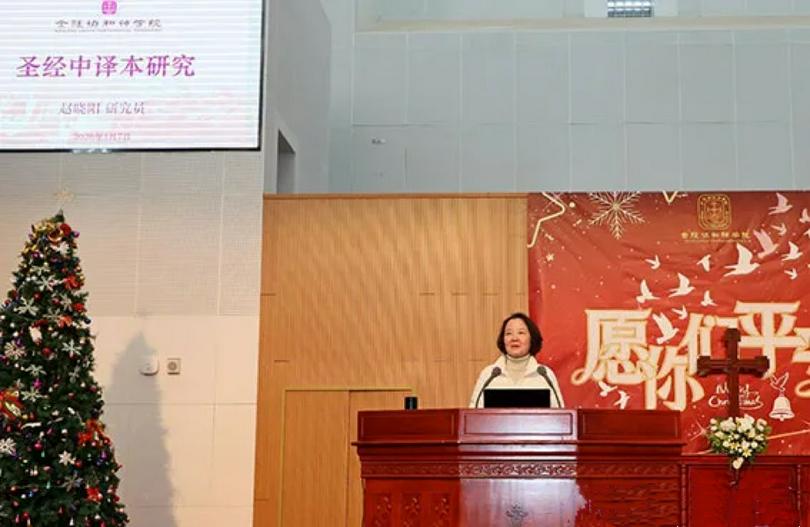
On January 7, Nanjing Union Theological Seminary in Jiangsu Province hosted a lecture titled "The Study of Chinese Translations of the Bible." The lecture was delivered by Zhao Xiaoyang, a researcher at the Institute of Modern History, Chinese Academy of Social Sciences.
Drawing on her first encounter with "Church Romanization (an orthography developed by Western missionaries for Southern Min)," Zhao traced the development of Chinese Bible translations along a historical timeline, said the seminary.
She offered a systematic overview of the major translation traditions within the three main branches of Christianity, with particular attention to vernacular Chinese versions and translations in ethnic minority languages in China. Through this approach, she outlined the historical contexts and textual features of various editions, providing faculty and students with a clear picture of the evolution of Chinese Bible translations.
Zhao further illustrated that the development of Chinese Bible translations has been closely intertwined with the evolution of the Chinese language itself. These translations bear distinct marks of their times in expression, script forms, and syntactic structures. She emphasized their lasting significance, noting that they contributed to the creation of written forms for ethnic minority languages, stimulated early exploration of the Latinization of Chinese characters, enriched the Chinese lexicon, and fostered the formation of new terms and renewed meanings through the adaptation and reinterpretation of traditional vocabulary.
Founded in 1952 through the merger of the original Jinling Theological Seminary and 11 East China theological institutions, Nanjing Union Theological Seminary is the national seminary of CCC&TSPM. Its first president was Bishop K. H. Ting, whose leadership helped shape the seminary's spiritual and academic foundations.
As of June 2022, the seminary offered undergraduate, master's, and doctoral programs, with approximately 500 full-time students and 23 faculty members. Over the decades, it has trained thousands of pastors, church workers, and theological educators.